The Ultimate Bow Guide: Compound vs. Recurve vs. Longbow
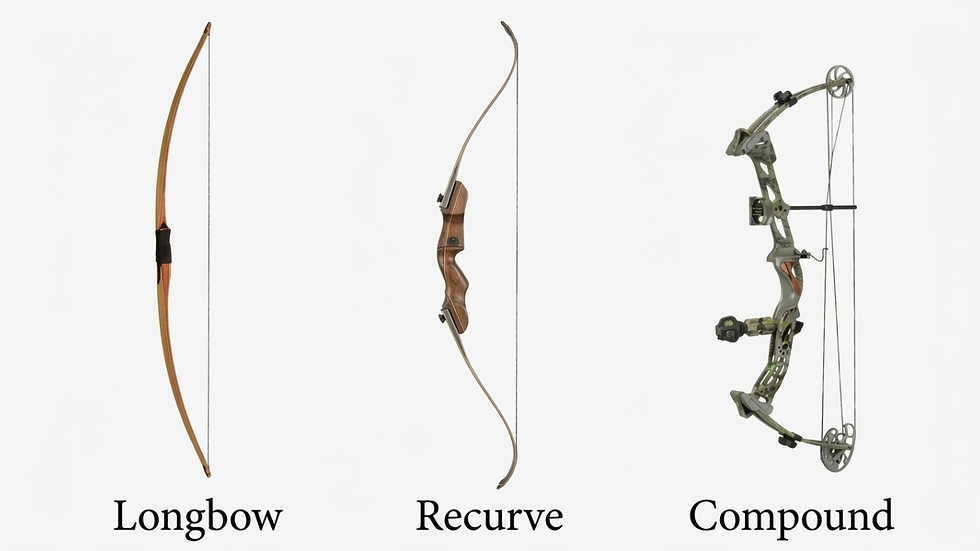
Whether you are stepping into a pro shop for the very first time or looking to switch up your hunting style, choosing the right bow is a deeply personal decision. When looking at a compound vs recurve vs longbow, the archery world broadly divides into these three major categories.
Each of these weapons carries its own unique history, distinct shooting mechanics, and performance benefits. Here is a breakdown of how they compare, the heritage behind them, and how to find the perfect fit for your archery goals.
The Longbow: Pure Heritage and Simplicity
The History
The longbow is one of the most transformative weapons in human history. While simple D-shaped bows date back thousands of years across various global cultures, the English Longbow became legendary during the Middle Ages. In the 14th and 15th centuries, Welsh and English archers dominated European battlefields—most famously at the Battle of Agincourt—using massive yew longbows that required immense strength to pull. Modern masters like Byron Ferguson proved that this ancient design still holds a vital place in the modern woods.
The Benefits
Featherlight Maneuverability: With no heavy accessories or complex cams, a longbow is incredibly light to carry through the woods all day.
Whisper Quiet: Because of its simple design and lack of moving parts, a well-tuned longbow is often the quietest bow you can shoot, giving game animals less time to "jump the string."
Fluid Intuition: Longbows are built for instinctive shooting. You don't rely on sights or pins; instead, you look at a target and let your subconscious mind guide your hands.
The Recurve Bow: Elegant Evolution
The History
The recurve bow represents an ancient engineering breakthrough. Unlike the straight limbs of a longbow, a recurve features tips that curve away from the archer when unstrung. Developed independently by ancient Asiatic cultures—including the Mongols, Persians, and Turks—this design allowed horseback archers to carry shorter, highly powerful weapons. Today, the modern recurve is the only bow style permitted in the Olympic Games, blending ancient design with cutting-edge materials like carbon fiber and foam laminates.
The Benefits
Increased Efficiency and Speed: The distinct "recurve" shape stores energy more efficiently than a straight longbow, delivering faster arrow speeds at the same draw weight.
Takedown Versatility: Revolutionized by archery legend Fred Bear, many modern recurves are "takedowns," meaning the limbs can be easily removed from the center riser. This makes them incredibly easy to pack, travel with, and store.
Interchangeable Components: Takedown recurves allow you to swap out your limbs for heavier or lighter draw weights as your strength evolves, without buying an entirely new bow.
The Compound Bow: Modern Mechanical Precision
The History
Compared to its traditional cousins, the compound bow is a modern infant. Invented in 1966 by Holless Wilbur Allen in Missouri, the compound bow revolutionized archery by introducing a system of cables and eccentric wheels (cams) to the ends of the limbs. This mechanical advantage fundamentally altered how energy is stored and held, turning archery from a test of raw physical endurance into a game of extreme, repeatable precision.
The Benefits
The "Let-Off" Advantage: When you pull a traditional bow back, the weight gets heavier the farther you draw. A compound bow does the opposite. Once you pull past the peak weight, the cam system "lets off" up to 80% to 90% of the weight. This allows you to hold a full draw for minutes at a time while waiting for an ethical hunting shot.
Unmatched Speed and Power: Compound bows shoot arrows significantly faster and with more kinetic energy than traditional bows, ensuring flatter trajectories over longer distances.
Accessory Customization: Compounds are built to host modern technology, including fiber-optic sights, drop-away arrow rests, stabilizers, and mechanical trigger releases that maximize accuracy.
Performance Comparison
To help visualize how these bows stack up mechanically, consider the primary trade-offs between physical effort at full draw and modern projectile speed:

How to Choose the Best Bow for You
The choice between traditional and mechanical archery comes down to what you want to experience when you step up to the target.
Choose a Longbow if:
You want to experience archery in its purest, most challenging form. If you value a lightweight setup, natural instinctive shooting, and the romance of traditional woodcraft over high-tech gear, the longbow is your perfect match.
Choose a Recurve Bow if:
You want a balance of tradition and performance. It is a fantastic option if you like the idea of traveling with a compact takedown bow, want the option to shoot barebow or with a basic sight, or dream of practicing the style seen on the Olympic stage.
Choose a Compound Bow if:
Your primary goals are precision, maximum effective range, and hunting efficiency. If you want to utilize modern sights, shoot tight groups at 40 yards and beyond, and have the mechanical advantage of holding a steady draw on a game animal, a compound is the clear choice.
Take the Next Step
The best way to truly know which bow fits your hands is to try them out yourself. Stop by a local archery pro shop, feel the weight of each bow style, and pull them back to experience the difference firsthand.
To watch all three styles of archery in action out in the field, tune in to Stoney Wolf Outdoors on Amazon Fire and Roku TV for incredible hunting footage and expert tips!



Comments